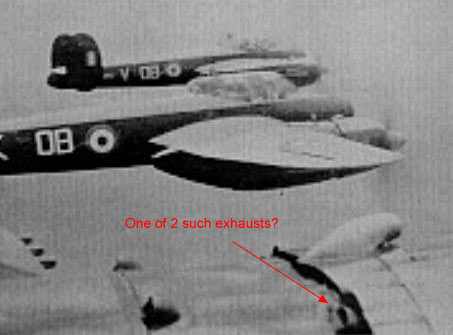
The picture above shows an exhaust peering out from under a cowling
which looks like the exhausts from the wreck's engine?
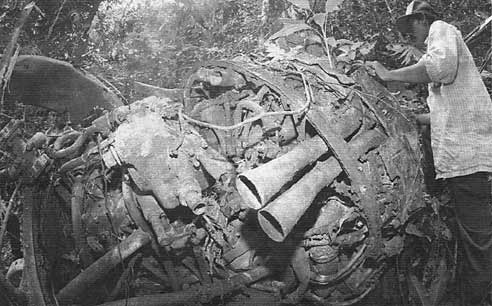
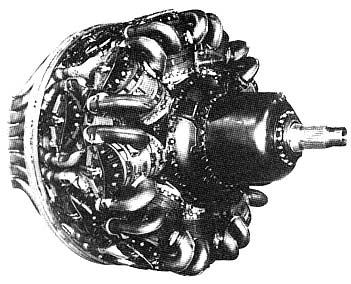
Caption: Last of the great Bristol piston engines, the Centaurus went into production in this form in 1943 as the 2,520-hp Mk V, with rear exhaust stacks for close cowling.
Picture credit: Peter Forbes, from Lister Cold-Starting Diesel Engines, kindly sent this picture to me for comparative analysis.
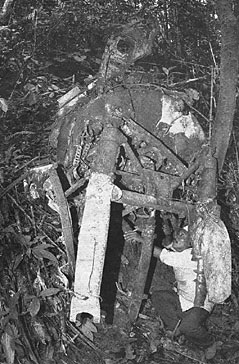

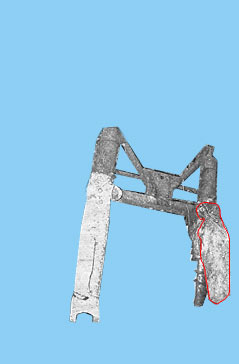
Undercarriage leg looks identical to that of the Bristol Brigand
as in photograph below
(Object outlined in RED is the "knuckle"?)
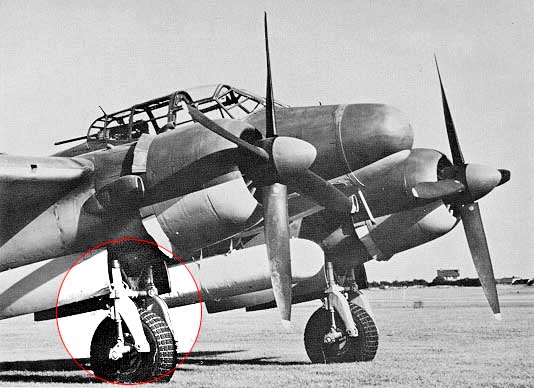
Bristol Brigand, First Production type Close-up
(Horizontally-flipped from original to show u/c
facing same direction as in wreck photo)
I can't help but think the undercarriage struts look very much like that in the photo above. I've isolated the strut from the rest of the background so that it's shape might be more easily made out.
What do you think?
The Tailfin
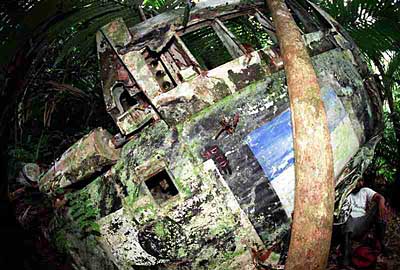
Picture of tailplane with RAF finflash. Note base colour is Black.
Tree in foreground is warped due to use of ultra wide-angle camera lens
(Picture from RMAF Museum page).
I feel that the following picture comparisons lend further weight to the wreck
being a Brigand:
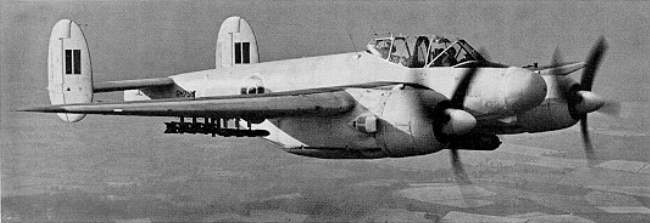
Here's a photo of a Coastal Command Brigand
which shows the outlines of the rudders clearly.
(photo from Peter Weston's site)
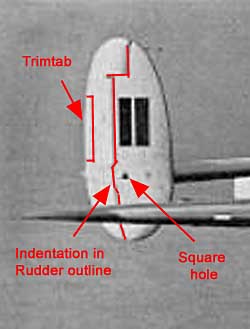
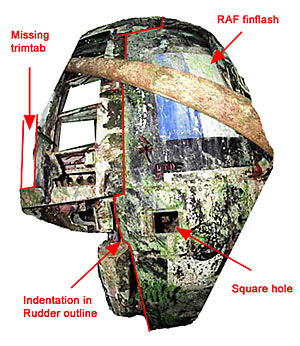
Above on the left, I have zoomed in on one of the rudders, while on the right is the picture of the wreck's tailfin, rotated to the vertical and distracting background is removed. I have labelled the corresponding similar parts in both tailplanes.
The indentation in the rudder, as well as the Square hole, are very distinctive features of the twin tailplanes, which leads me to the conclusion that our wreck is indeed a Bristol Brigand.
I also received an email from aviation enthusiast Wong Lai-Toon (who grew up in Ipoh) that corroborates this:
"Hi there Sunny, This is Lai-Toon emailing you from Fremont. I am almost sure that you are correct as my dad, who was in the Home Guard as a sergeant during the days of the British involvement in the suppression of the commies during the late 40's to late 50's in the Perak region.
When I was a kid, I remembered him talking quite a few times about a crash in the Lenggong area during his many get-togethers with his friends. Though the name Brigand escaped me, and perhaps my dad, I believe that it is very likely it is the same crash. There was someting about a rescue mission that was fruitless, etc. - vague memories, these.
Your article pleasantly brought back these long forgotten nostalgic memories. I can still remember that I did ask him once during my early teen years when I was starting to have my passion for planes, but his memory was fading by then and sadly that was the end of that subject with him."
Thanks for your email, Lai-Toon! Well, there you have it folks! Is the proof conclusive enough? What do you think?
Send email

